Wednesday, 20 July 2016

05 Summer Research: 02


Magic Leap is a secretive startup who are developing what the CEO refers to as a "Mixed Reality" device. His objective is to create images in the real world seem realistic by using a mix of AR and VR. Using a chip with specific patterns inside it supposedly then tricks the brain into believing the images put before the user are real. Many responses seem to compare this to Microsoft's Hololens, however we've yet to see what exactly Magic Leap will bring forward physically for this project.


US software development company Niantic partnered up with Nintendo to produce a free-to-play AR game for iOS, Android and Apple Watch devices. It was announced on September 2015 that Niantic were developing an app with Nintendo and The Pokemon Company. With over 500 million downloads all over the world, Pokemon GO made it as one of the most used and profitable gaming app of 2016. It's praised points is its location-based AR gaming, physical activity and promoting local businesses.

Wednesday, 20 April 2016

05 Summer Research: 01


Based in Liverpool, this studio consists of innovative artists, programmers and designers who work together to produce engaging art using emerging technologies. This team were behind the Marks and Spencer projection mapping and the city-wide augmented reality treasure hunt in Liverpool 2014 during the Christmas holiday.


IKEA has joined many other companies in using VR technology to promote their products. Using the digital distribution platform Steam IKEA have made a VR experience within the kitchen allowing players to design, alter and interact with a premade kitchen. The VR support is the HTC Vive, using motion-tracking controllers and a room scale play area, the player is able to walk around the kitchen as well as change the height of the in-game character to view the room from different perspectives. Reviews for this interactive game on Steam however seem to delivery few legitimate


Delightex is a startup based in Munich and CoSpaces is the main project they currently are working on. CoSpaces is a free online platform where you can create a 3D space and using a library of objects and characters you can make your own virtual world. Using your smartphone you can experience your creations in VR. Support for the Oculus, Gear VR and HTC Vive are in development.

Monday, 28 March 2016

04 Virtual Reality head-mounted displays of 2016


The Oculus Rift was the first consumer-targeted VR head-mounted display (HMD) which started as a Kickstarter back in August of 2012. The Oculus has been through 5 iterations and finally the consumer version is ready to be shipped, first batch was being shipped on the 25th March this year.
Compared to it's original version where the wearer was limited to rotating their head and to remain seated while using either a console controller or keyboard, the newest version now has infrared (IR) sensors which allow the wearer to be able to move within the virtual world within the confines of the room they're using the HMD in. There are also optional Oculus Touch controllers allowing wearers to also interact with objects in the virtual world.


The HTC Vive is one of the competitors of the Oculus Rift which also integrates IR sensors and motion-tracked handheld controllers. Pre-orders for this HMD started on the 29th February and I'm currently subscribed to a Youtuber (Jacksepticeye) who has this device currently and has already played a variety of VR games. The HTC Vive was developed by HTC and Valve company.


The third competitor in VR HMDs this year is the PlayStation VR. Sony's interest in head-mounted technology dates back in the 1990's, in 1997 the Glasstron was in the US markets. It had 2 LCD screens and 2 earphones for video and audio was the first. So in a sense, this HMD is its successor. The PlayStation VR has 9 positional LEDs on its surface so the PlayStation camera can capture the 360 head movements. In some events, this HMD will require the PlayStation Move controllers.  Its official release will be October this year.

Tuesday, 15 March 2016

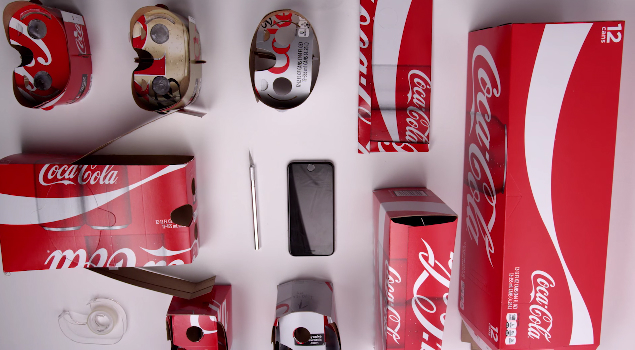
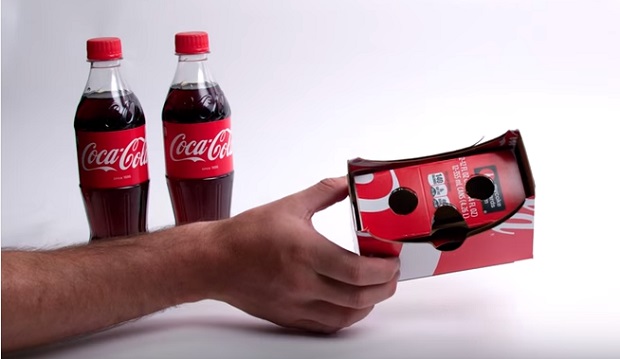
03 Coca-Cola 12 pack VR viewer


Youtube video on how to make the viewers: http://bit.ly/1QHiNLF
Coca-Cola have also decided to advertise themselves through their 12 pack cardboard packaging, though unlike the McDonalds' Happy Goggles, this process requires a cutting tool and some tape to keep it together.

Wednesday, 9 March 2016

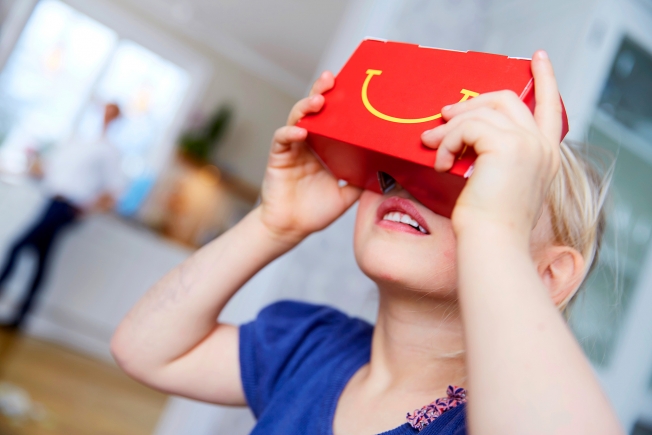
02 Happy Goggles

http://happygoggles.se/

McDonald's participation within the Virtual Reality hype is in the form of a foldable viewer made from their limited edition Happy Meals boxes. Similar to the Google Cardboard, a virtual and augmented reality platform made by Google engineers David Coz and Damien Henry, Happy Goggles are made to hold a smartphone which is a much more affordable way to introduce VR to a large audience. The user can download the app game "Se upp i backen" ("Watch out on the slopes" in English) on their website and play using their newly forged cardboard VR viewer. These limited Happy Goggles were available in Sweden from March 5th 2016.

Whether this is McDonalds way to further popularize their company or to enhance their customers' experience with their meal, it's no surprise that a large fast food restaurant company is joining arms with the trending Virtual Reality phenomenon.

Wednesday, 2 March 2016

01 Research Kickstarter: Images


Ivan Sutherland, computer scientist and
internet pioneer
Edwin Link, pioneer in aviation, underwater
archaeology, and submersibles

"Sword of Damocles" VR Headset devloped
by Ivan Sutherland
"Link Trainer" Edwin Link's flight simulation
for the US army


Peter von Hess's painting of "Battle of Borodino"
Morton Heilig's "Sensorama", a personal theater cabinet


Stereoscopic photography
1939, William Gruber's View-master
Richard Stallman, freedom activist and computer programmer

Nintendo's "Virtual Boy" virtual reality table-top video game console

HTC and Valve's HTC Vive VR Headset
Oculus VR's Oculus Rift VR headset

Sony Computer Entertainment's Morpheus VR headset

Nonny de la Pena's "Virtual Realty Journalism" using CGI to reconstruct stories she's covered

Chris Milk's "Virtual Reality Journalism" using 360 camera to document "Clouds over Sidra"

Delegates at Davos experiencing the 360 documentary "Clouds over Sidra"

"Clouds over Sidra"

01 Research Kickstarter

Eye magazine article:
http://www.eyemagazine.com/feature/article/tangible-digital-intro


I signed up to the Liverpool Central Library club and borrowed the following books:


Multimedia Histories - From the Magic Lantern to the Internet
edited by James Lyons and John Plunkett


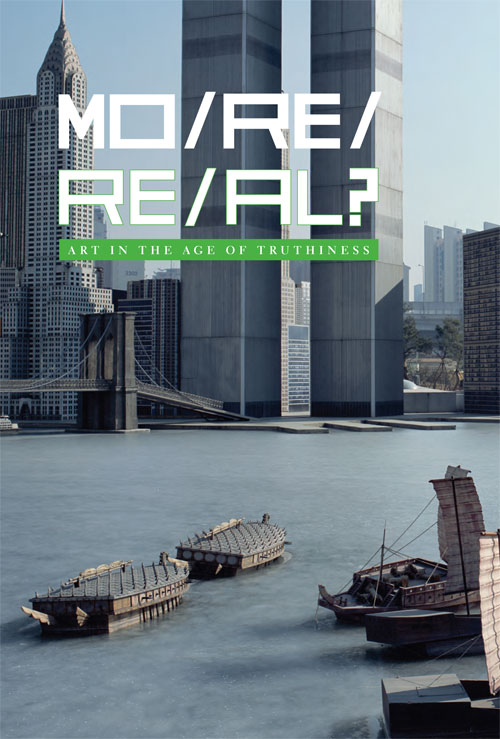
MO/RE/RE/AL? - Art in the age of truthiness

Elizabeth Armstrong


Youtube video playlist:

https://www.youtube.com/watch?v=USyoT_Ha_bA&list=PLq8HyphCfUf18n6l2gieR1KpUm-fZawYG